Wedding Photography DOF Calculator: Perfect Focus Every Time
The exchange of vows, the first kiss, the tearful joy on a parent's face—these are the unrepeatable moments that define a wedding day. As a wedding photographer, your mission is to capture these fleeting memories with perfect clarity. But in the fast-paced, high-pressure environment of a wedding, how do you guarantee that every critical shot is perfectly sharp?
Many photographers struggle with controlling depth of field (DOF), the zone of acceptable sharpness in an image. This can lead to missed focus on a crucial detail or a group photo where half the people are blurry. This guide will walk you through the specific DOF challenges of wedding photography. I'll show you how to master everything from intimate ring shots to large group photos. With a little planning and the right tool, you can achieve flawless focus every time. Our intuitive DOF calculator makes this planning simple and visual.

Understanding Wedding Photography DOF Challenges
Wedding photography demands incredible versatility. In one moment, you are capturing a wide, sweeping shot of the entire venue. In the next, you are zoomed in on the delicate lace of the wedding dress. Subject matter, distance, and composition change constantly throughout a wedding. This creates unique depth of field challenges that demand both quick thinking and precise execution.
The Two Extremes: Intimate Close-ups vs. Expansive Groups
The core challenge lies in managing two opposite scenarios. First, you have the intimate close-ups. Think of the wedding rings, a single flower in the bouquet, or the detail on an invitation. For these shots, you often want a shallow depth of field to create a soft, blurry background that makes the subject pop. This requires a wide aperture (a low f-stop number) and careful focusing.
On the other hand, you have the expansive group photos. Capturing the entire wedding party or all the guests together requires a deep depth of field. You need everyone, from the front row to the back row, to be sharp and in focus. This demands a narrower aperture (a higher f-stop number) and a different approach to focusing. Balancing these two extremes throughout the day is a key skill for any wedding photographer.
Time Pressure and the Need for Pre-Planning
Weddings run on a tight schedule. You don't have the luxury of spending ten minutes setting up a single shot. The ring exchange happens in seconds, and group photos need to be organized quickly before guests get restless. This time pressure means you can't afford to guess your camera settings and hope for the best.
This is where pre-planning becomes your most valuable asset. Use a depth of field calculator before the wedding to understand how your specific lens and camera will perform in various shooting scenarios. Simulating your shots ahead of time allows you to develop a clear plan. You'll know exactly which aperture, focal length, and focusing distance to use for each situation. This preparation frees you to focus on composition and capturing emotion, knowing your technical settings are already dialed in.
Mastering Ring Shots and Close-ups with DOF Calculations
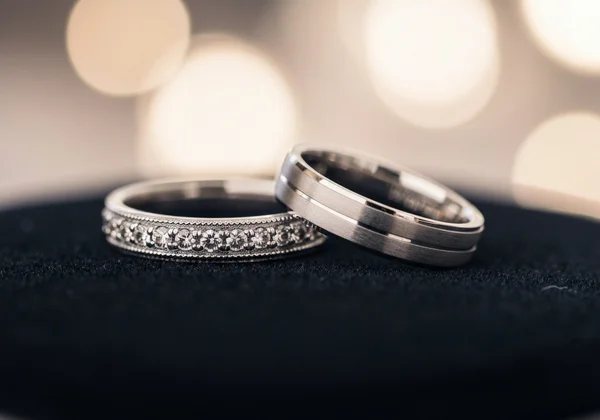
The ring shot is an iconic part of any wedding album. It symbolizes the couple's commitment and showcases the beautiful details of their chosen rings. However, it's also one of the trickiest shots to get right due to the extremely shallow depth of field involved in macro or close-up photography.
Lens Selection and Aperture Settings for Perfect Ring Detail
To capture stunning ring shots, most photographers use a dedicated macro lens (like a 100mm macro) or extension tubes. These allow you to focus much closer to the subject than a standard lens. When you're this close, your depth of field becomes razor-thin, sometimes only a few millimeters deep.
Choosing the right aperture is crucial. A very wide aperture like f/2.8 might seem tempting for a blurry background, but it could leave parts of the ring out of focus. You might find that a slightly narrower aperture, such as f/5.6 or f/8, provides enough DOF to get the entire main diamond and setting sharp while still beautifully blurring the background. Experimenting with a DOF planning tool can reveal the perfect balance for your specific lens and setup.
Calculating Focus Distance for Small Subjects
When working with tiny subjects like rings, precision is everything. You need to know exactly where your focus plane lies. A DOF calculator is essential for this. By inputting your camera model, lens focal length, chosen aperture, and your distance to the rings, the tool will tell you the exact depth of your sharp zone.
For instance, you might discover that at a distance of 30 cm with a 100mm macro lens at f/4, your total depth of field is only 2 millimeters. This tells you that your focusing must be absolutely perfect. The visualizer on our tool helps you see this tiny sharp area, empowering you to adjust your camera position or aperture to ensure the most important parts of the rings are perfectly in focus.
Ensuring Sharp Group Wedding Photos
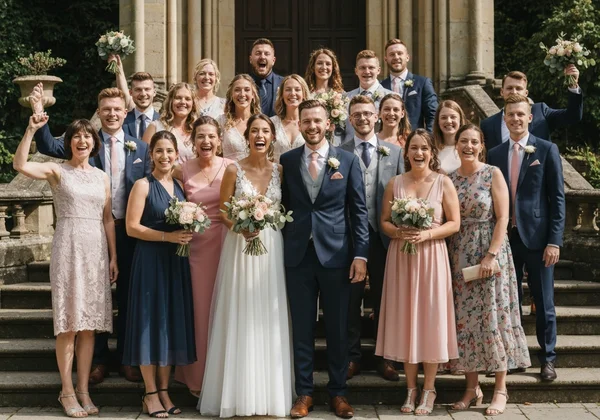
After mastering the close-ups, the next major challenge is the group photo. Whether it's the bridal party of ten or the entire guest list of one hundred, your job is to make sure every smiling face is sharp. This is where a deep depth of field and a technique called hyperfocal distance become your best friends.
Setting Up for Large Groups: Position and DOF Planning
The first step is arranging the group. Whenever possible, try to arrange people in as few rows as possible. Staggering people on stairs or a gentle slope is an excellent way to keep everyone's face on a similar plane of focus. The more rows you have, the deeper your depth of field needs to be.
Next, you need to choose your settings. A wider-angle lens (like a 35mm or 50mm) is often better for groups than a telephoto lens, as it naturally has a greater depth of field. You will also need to use a narrow aperture, such as f/8, f/11, or even f/16, to maximize the zone of sharpness. Before you take the shot, you can quickly check your settings to confirm your DOF will cover everyone from the front row to the back.
Calculating Hyperfocal Distance for Maximum Scene Sharpness
For the ultimate in front-to-back sharpness, especially in very large groups or when you want the background sharp too, you should use the hyperfocal distance. This is a specific focusing distance that maximizes your depth of field. When you focus at the hyperfocal distance, everything from half that distance all the way to infinity will be acceptably sharp.
Instead of trying to remember complex formulas, a hyperfocal distance calculator does the work for you. Simply enter your camera, focal length, and aperture into our online DOF calculator, and it will instantly tell you the hyperfocal distance. By focusing your lens at that exact point, you can be confident that you’ve achieved the maximum possible sharpness for your group shot.
Real-world Wedding Scenarios: DOF Calculator in Action
Theory is helpful, but seeing how these tools work in practice is what builds confidence. Let's walk through two common, high-stakes wedding scenarios and see how a DOF calculator can save the day.
Case Study: The Perfect Ring Shot Under Challenging Lighting
Imagine you are in a dimly lit reception hall and need to get the ring shot. The low light tempts you to use a wide aperture like f/1.8 to gather more light. However, you are using a 100mm macro lens from about 40 cm away. A quick check on a DOF calculator reveals that at f/1.8, your total depth of field is less than 1 millimeter. This is too risky; even the slightest movement could throw the shot out of focus.
The calculator shows that stopping down to f/5.6 increases your DOF to about 3 millimeters. This is a much safer margin. Knowing this, you can confidently set your aperture to f/5.6 and compensate for the low light by slightly increasing your ISO or using a small portable light. The result is a perfectly sharp ring shot, all thanks to a minute of planning.
Case Study: Managing Focus in a 50-Person Wedding Party
You are tasked with photographing a 50-person wedding party arranged in four rows on the steps of a church. You are using a 35mm lens on a full-frame camera and want everyone to be sharp. You arrange the group, measuring that the front row is 5 meters away and the back row is 7 meters away.
Your instinct might be to focus on the front row and use an aperture of f/8. But will that be enough? You pull out your phone and use a DOF simulator. You input your settings: 35mm lens, f/8, and a focus distance of 5 meters. The calculator shows your depth of field extends from 4.1m to 6.6m. The back row at 7 meters will be soft! By simply changing your focus point to 6 meters, the new DOF range covers 4.7m to 8.2m, ensuring everyone is sharp. Better yet, the tool tells you the hyperfocal distance for f/8 is 5.86 meters. Focusing there guarantees sharpness from 2.93 meters to infinity. You've just saved the most important group photo of the day.
Your Path to Flawless Wedding Photography Focus
Mastering depth of field is what separates good wedding photographers from great ones. It's the technical skill that allows your creative vision to shine. By understanding the different demands of intimate details and large groups, you can approach any situation with confidence. The key is not to guess, but to plan.
Using a reliable tool to calculate your settings beforehand removes the anxiety and uncertainty from high-pressure moments. It transforms a complex optical formula into a simple, actionable plan. This allows you to stay present, connect with the couple, and focus on capturing the emotion of the day, secure in the knowledge that your images will be technically perfect.
Transform your wedding photography today with the confidence that comes from knowing your settings are perfect. I've used our DOF calculator to save countless shots on wedding days - from perfectly focused ring details to crystal-clear group portraits. Try our DOF calculator and experience the difference precise planning makes when capturing those once-in-a-lifetime moments.
Frequently Asked Questions About Wedding Photography DOF
What aperture should I use for wedding portraits?
For individual or couple portraits where you want a soft, blurry background, a wide aperture like f/1.4, f/1.8, or f/2.8 is ideal. For small groups of 2-4 people, stopping down to f/4 or f/5.6 helps ensure everyone is in focus. Always check your focus on the subjects' eyes.
How do I calculate DOF for large wedding groups?
For large groups, use a moderate wide-angle lens (like 35mm or 50mm) and a narrow aperture (f/8 to f/11). The best method is to use a hyperfocal distance calculator. You can find one here. Focus at the calculated hyperfocal distance to get maximum sharpness from front to back.
Can a DOF calculator help with challenging lighting conditions?
Yes. In low light, you may be tempted to use a very wide aperture. A DOF calculator can show you just how thin your focus plane will be, helping you decide if you need to find a safer aperture and compensate with a higher ISO or additional lighting to avoid missed focus.
What's the best lens for wedding ring photography?
A dedicated macro lens, typically around 100mm, is the best choice. It allows for 1:1 magnification and gives you a comfortable working distance from the rings. Because macro work results in very shallow DOF, planning your shot with a focus calculator is highly recommended.
How does focal length affect DOF in wedding photography?
Focal length has a major impact on depth of field. Longer focal lengths (telephoto lenses like 85mm or 135mm) produce a much shallower depth of field at the same aperture and distance compared to shorter focal lengths (wide-angle lenses like 35mm). This is why telephoto lenses are great for isolating subjects in portraits, and wide-angle lenses are better for getting everything in focus for group shots.